How does Bluetooth Low Energy work and when should you use it?
How Bluetooth Low Energy advertising, GATT, connections and mesh work, what the 5.x releases added, and when BLE is the right link for an IoT product.
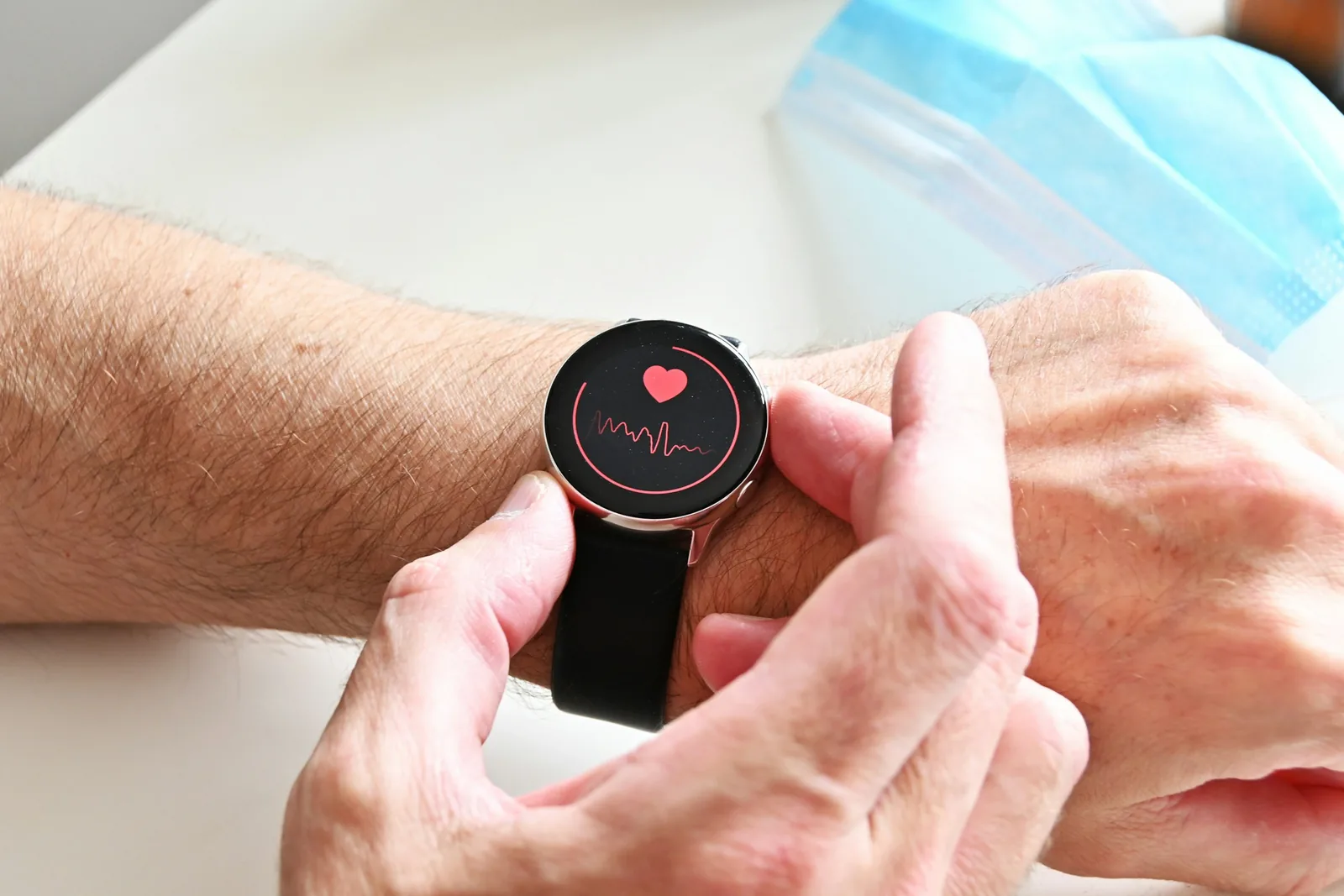
Photo: Nik / Unsplash
After reading this article you will be able to:
- Explain how advertising, connection intervals and deep sleep make a coin cell last for years
- Describe how GATT services and characteristics expose a device's data to a phone app
- Decide when BLE fits a product and when LoRaWAN, Wi-Fi or Thread is the better link
On this page
Bluetooth Low Energy is probably the most widely shipped IoT radio in the world, for a simple reason: every phone has it. A sensor that speaks BLE can be configured, read and updated from a device the user already owns, without a hub, a gateway or a cloud account.
BLE arrived with Bluetooth 4.0 in 2010 as a separate protocol from classic Bluetooth, sharing the brand and the 2.4 GHz band but little else. It was designed for devices that send small amounts of data occasionally and spend most of their life asleep, which describes a large share of IoT hardware.
This guide explains the mechanics that make BLE efficient, the data model developers actually program against, what later releases added, and the situations where BLE is the wrong choice.
How does the radio save power?
BLE splits the 2.4 GHz ISM band into 40 channels of 2 MHz. Three of them (37, 38 and 39) are reserved for advertising, and they are placed to avoid the most common Wi-Fi channels. The remaining 37 are data channels, hopped through during a connection to dodge interference.
A BLE device spends almost all of its time with the radio off. A peripheral wakes briefly to broadcast an advertising packet, listens for a moment in case someone answers, and sleeps again. In a connection, the two sides agree on a connection interval, from a few milliseconds up to a few seconds, and only wake at those moments. A peripheral can also ask to skip a number of intervals when it has nothing to say. Short on-air time plus deep sleep in between is what makes a coin cell last for months or years.
Which roles can a BLE device play?
BLE defines roles by what a device does on air. A peripheral advertises and accepts connections; a central scans and initiates them. A phone is almost always the central and the sensor the peripheral. A device can also be a pure broadcaster that advertises and never connects, which is what a beacon is, or a pure observer that only scans.
Connections are point-to-point. A central can hold several connections at once, and modern stacks allow a device to be central and peripheral simultaneously, but there is no native routing between peripherals outside of mesh, covered below.
What is GATT?
Once connected, devices talk through the Generic Attribute Profile (GATT). A GATT server (usually the peripheral) exposes a table of attributes organized into services, each containing characteristics, each of which holds a value and descriptors that describe it. A heart-rate monitor exposes a Heart Rate service with a Heart Rate Measurement characteristic; a custom temperature sensor exposes a vendor-defined service with its own 128-bit UUIDs.
The client can read a characteristic, write it, or subscribe to notifications so the server pushes new values as they arrive. Notifications are how a sensor streams readings without the phone polling. The maximum payload per attribute operation depends on the negotiated MTU, which is small by default and can be raised on newer stacks.
The Bluetooth SIG publishes standard services for common device classes (battery level, environmental sensing, device information, glucose, cycling power and many more). Using them means third-party apps understand your device without custom code. Vendor-defined services give you full freedom at the cost of needing your own app.
How can advertising work as a data channel?
Advertising packets carry up to 31 bytes of payload in the legacy format, and that payload can be data, not just a name. Many IoT designs never connect at all: a temperature tag encodes its reading into each advertisement, and a gateway or phone simply listens. This is the broadcaster model, and it scales to hundreds of tags in a room because no connections are maintained.
Bluetooth 5 added extended advertising, which allows much larger payloads spread across secondary channels, and periodic advertising, where receivers can synchronize to a broadcaster’s schedule and sleep in between. Bluetooth 5.4 added Periodic Advertising with Responses, designed for electronic shelf labels, where a single access point updates thousands of battery-powered displays on a schedule and gets acknowledgements back.
What did Bluetooth 5.x change for IoT?
Bluetooth 5 introduced two new physical layers next to the original 1 Mbps PHY. The 2 Mbps PHY doubles throughput for firmware updates and data dumps. The Coded PHY trades speed for range: by spreading each bit over several symbols it extends the usable distance substantially, enough to cover a house or a small warehouse from a single point. Range in practice still depends on the antenna, transmit power and walls, so treat vendor range figures as best-case.
Bluetooth 5.1 added direction finding (angle of arrival and angle of departure), which lets a fixed array of antennas estimate where a tag is, with accuracy the Bluetooth SIG describes as centimeter-level in good conditions, a real improvement over signal-strength-based positioning. Bluetooth 5.2 brought LE Audio and isochronous channels, more relevant to hearing aids and earbuds than to sensors, and the Enhanced ATT protocol that allows parallel GATT transactions. More recently, Bluetooth 6.0 (September 2024) added Channel Sounding, a secure distance-measurement feature aimed at digital keys and item finding, and the core specification has since reached version 6.2.
What is Bluetooth Mesh?
Point-to-point BLE does not scale to a building full of lights. Bluetooth Mesh, published in 2017, adds a flooding mesh network on top of BLE advertising: every mains-powered node relays messages it hears, so a command reaches every light within a few hops. Battery-powered nodes join as low-power nodes that rely on a friend node to buffer their traffic. The model is publish-subscribe with group addresses, which suits lighting control and building sensing. It competes with Zigbee and Thread in those spaces, and is a separate stack from the GATT world, so a mesh light and a phone app usually meet through a gateway or a proxy node.
When should you use BLE, and when not?
BLE fits when a phone or tablet is the natural user interface, when the device runs on a coin cell or small battery, when data volumes are small, and when range of a room or a building is enough. Wearables, medical sensors, asset tags, beacons, smart locks and setup channels for Wi-Fi products are all natural fits. Even Matter uses BLE for commissioning before the device joins Wi-Fi or Thread.
BLE is a poor fit when the device needs to reach the internet on its own without a phone or gateway nearby, when it must cover a campus or a field, when it streams high-bandwidth data such as video, or when it needs deterministic timing. For long-range battery sensing, look at LoRaWAN or NB-IoT; for high throughput, Wi-Fi; for IP-native home mesh, Thread.
One more trap: BLE on phones is mediated by the operating system, and background scanning, pairing dialogs and reconnection behavior differ between iOS and Android and between versions. Budget engineering time for the app side, not just the firmware.
Where to go next
- IoT connectivity overview puts BLE next to the other short- and long-range options.
- Thread explained covers the IP-based mesh that competes with Bluetooth Mesh in the home.
- Matter explained shows how BLE is used as the setup channel for a standardized smart home.
- October 17, 2026: direction-finding accuracy corrected to the Bluetooth SIG description (centimeter-level); Bluetooth 6.0 Channel Sounding and core specification 6.2 added; sources linked
How corrections are handled: editorial policy.
Topics: Bluetooth Low Energy, BLE, GATT, beacons, short-range wireless